The method I used to reach B2 Spanish in one year
Note: If you just want to read about the tools I used and how they worked or didn't work, you can find that here.
tldr, just tell me how you did it
- I started with Duolingo and developed an early intuition of the language
- I entered a resource exploration phase, finding the apps and tools that worked for me
- I read Gabriel Wyner's "Fluent Forever"
- I used Anki to learn the most frequent words in the Spanish language
- I began having weekly conversations with native speakers on italki
- I watched content on Dreaming Spanish, increasing the difficulty of the content over time
- I read a lot of children's books in Spanish to my daughter
- I listened to podcasts and watched Youtube videos in Spanish, beginning with easier content meant for language learners and progressing to content for native speakers
- I began reading books in Spanish for native speaking adults
- I switched to only reading the news in Spanish
- I switched from creating Anki vocabulary cards to more complex types of cards, creating cards became less frequent
- Miscellaneous things along the way: talking with friends, writing and speaking to ChatGPT, device settings in Spanish, listening to Spanish music
Background
I began a serious pursuit of learning the Spanish language in December of 2024, beginning somewhere in the early A1 level and having reached somewhere in B2 territory at the time of writing this (this level system, consisting of levels A1, A2, B1, B2, C1, C2, comes from the Common European Framework of Reference for Languages (CEFR)).
Why adults believe they can't learn new languages
We are often told that it's far more difficult to learn a language as an adult than it is as a child. Kids have higher neuroplasticity, they are better at absorbing sounds and accents, they pick up correct pronunciation with greater ease. That's all true, but where people go wrong with this line of thinking is they assume that neuroplasticity is the primary bottleneck when learning a language.
But this turns out to be a much smaller factor than people think, one that is easily overcome by the advantages adults bring to the table. For example, between December 2025 and December 2026, I built a Spanish vocabulary of over 5000 words, and that's a conservative number. It doesn't count the many verb conjugations and vocabulary I picked up passively via comprehensible input consumption and pattern applications. My three-year-old has an incredible ability to acquire an intuition for Spanish, to pronounce correctly, to absorb the language. But there is an entire cognitive toolbox that she does not yet have access to that she would need to do this same task and other language learning efforts.
More concretely, adults can:
- deliberately build abstractions
- set and track goals
- tolerate delayed gratification
- choose efficient representations of information
- deliberately revisit weak spots
A few hard truths
So adults have some solid tools to employ when learning a language, but this doesn't mean there aren't a few facts we can't get around.
Learning a language requires a serious time commitment.
There's no getting around this fact. You do need exposure to a large volume of content in your target language, and acquiring that exposure takes time. The good news is that there's a relatively early inflection point at which you can start consuming content that you'd be perfectly happy consuming in your native language.
A single tool/app/resource that will take you all the way to fluency probably does not exist (yet).
There is rich ecosystem of apps, tools, books, and other resources in the language-learning space. The trick is combining them in a way that work for you.
Progress becomes increasingly difficult to "see".
Early progress signals are loud. Your vocabulary doubles in size with high frequency. You're rapidly acquiring grammar structures and ways of expressing things. Reaching "survival-level" in your target language arrives early, and all this rich positive feedback feels fun and keeps you engaged.
But pretty quickly your vocabulary feels like it is growing more slowly. Naturally, you are now learning the words and phrases and structures that appear less frequently in the language, which means opportunities to use them and notice you've used them are rare.
Your improvements are still there, but they're diffuse, slightly adding strength to a broader swath of the language.
How I began and why it didn't work (but was still essential)
The app you knew you'd hear about
I began the language-learning journey the same way so many people today do: I downloaded Duolingo. I was immediately hooked. The app made language learning feel approachable and engaging, with just enough gamification to keep me coming back day after day.
A lot of people, especially serious language learners, are quick to dismiss Duolingo as ineffective or unserious. But I actually found it very effective as a starting point. It helped me build early intuitions about Spanish, gave me some initial vocabulary to work with, and perhaps most importantly, fostered a positive association with language learning in my brain.
For me, the turning point came when I realized I was no longer coming back for the learning, but for the leaderboard. New vocabulary and grammatical structures were arriving too slowly to feel meaningful. I was growing bored with the content itself, yet the gamification kept me pushing through anyway. I also began to notice that many people using the app were optimizing for maintaining a streak, not for actually improving in their target language.
The resource exploration phase
As my enthusiasm for Duolingo began to fade, I started looking at what else was out there. I discovered Dreaming Spanish and began watching their content after spending some time learning about comprehensible input. I tried apps like LingQ in hopes of finding efficient ways to build vocabulary while still consuming large amounts of understandable content. I tried classic school-style grammar books and I read books written with the principles of comprehensible input in mind. I watch Youtube videos of people ranking the various apps and explored all the S and A-tier recommendations. Some of these things I left behind almost immediately, others I used for months, and a select few I still use today.
The key here was spending time finding the things that worked for me, the things that I enjoyed using. What I still lacked was a proper system.
The turning point
I knew that somewhere along the way I would want to incorporate a spaced-repetition system to help cement some of the vocabulary and phrases I was encountering, but I didn't love the idea of creating an Anki card for every new piece of Spanish, and I wasn't sure at the time what a better approach might be. Luckily, the answer was (unsurprisingly) in a particularly well-regarded language learning book: Gabriel Wyner's "Fluent Forever".
Language learning as a systems problem
The distribution of language
Wyner's book was full of useful tips and resources, but if I had to choose one resource he covers that helped accelerate my journey to B2, it would be the frequency dictionary. This tool addressed the problem I had in deciding for which content I should create flash cards.
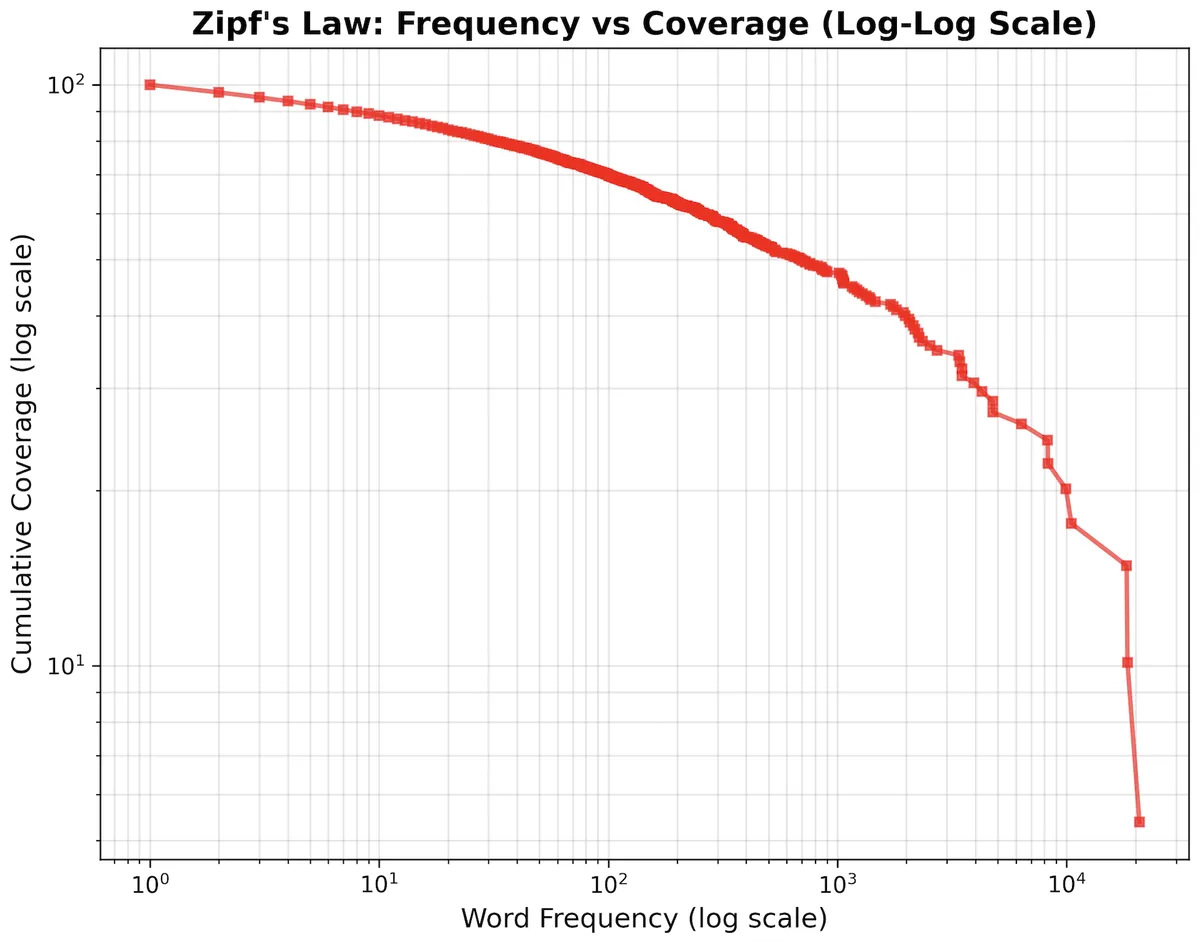
The idea is to learn the most frequently-occurring vocabulary first, providing the most efficient possible path toward understanding the majority of content you encounter. It turns out that language doesn't distribute evenly, and a relatively small number of high-frequency words account for a surprisingly large share of what you read and hear.
Here's an analysis on the entire text of Don Quixote. You can see how the highest frequency values on the right account for the sharpest spike in cumulative coverage. More concretely, 'que' and 'de' together account for 10% of Don Quixote.
So I acquired a frequency dictionary and started from entry 1. I used the following rules for creating Anki flash cards:
- Couldn't translate Spanish to English OR English to Spanish? One card for both directions.
- The Spanish to English translation is obvious but I wouldn't be able to recall the Spanish translation from the English word? One card for English to Spanish.
- Already know both Spanish to English and English to Spanish? Do nothing.
Spaced repetition systems: efficient memorization
Anki employs the power of recall's effect on long-term memory. When you learn something, much of what you stored in memory begins to decay quite rapidly, and if you do nothing to reinforce it, you eventually leave it behind in a learning silo.
Alternatively, you can force yourself to recall the information and strengthen its representation in your brain. Each time you do this, you push out the date at which you'll likely forget it. This is visualized in this "forgetting curve."
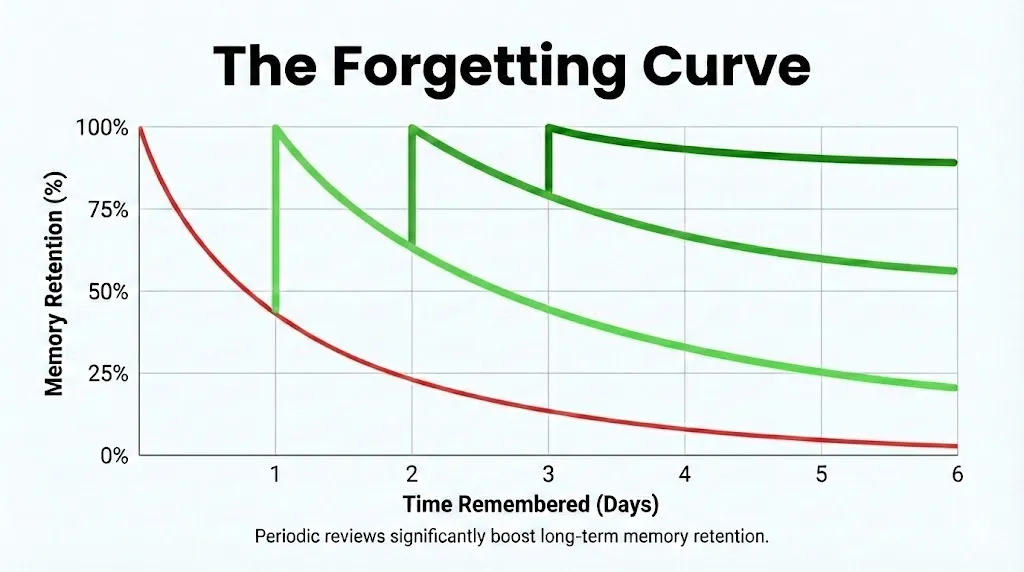
This is why flash cards work. But flash cards accumulate, and the last thing you want is a pile of 5000 flash cards that you review on a regular basis. That would be a great way to drain your motivation for language learning.
This is where spaced repetition shines. It provides algorithms for deciding when you're just about to forget something, and only then does it present that flash card for another recall. And because of the effect discussed above, this "recall date" is farther and farther away for each successful recall. The effect is those 5000 flash cards eventually needing review months to years in the future. The task of keeping things in memory is orders of magnitude less daunting when using such a system.
(To be continued...)