Unlabeled puzzle design: good decoys are all you need
Zooming in on one puzzle's decoy label that 75% of players picked
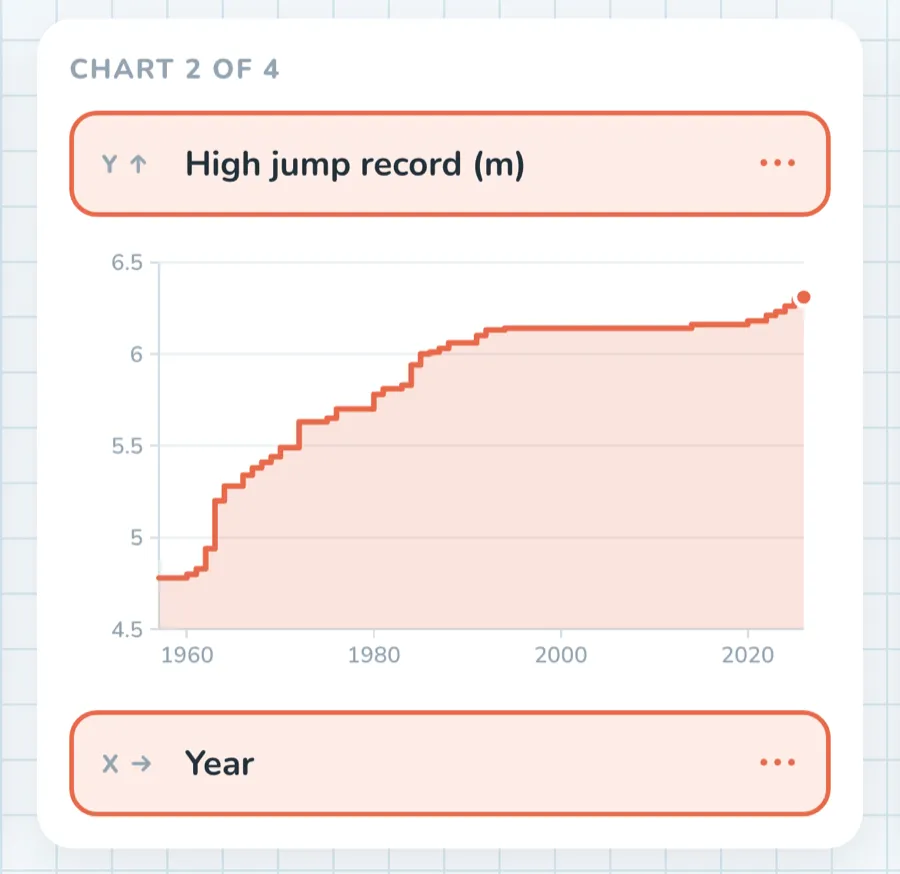
Can you identify what this chart represents?
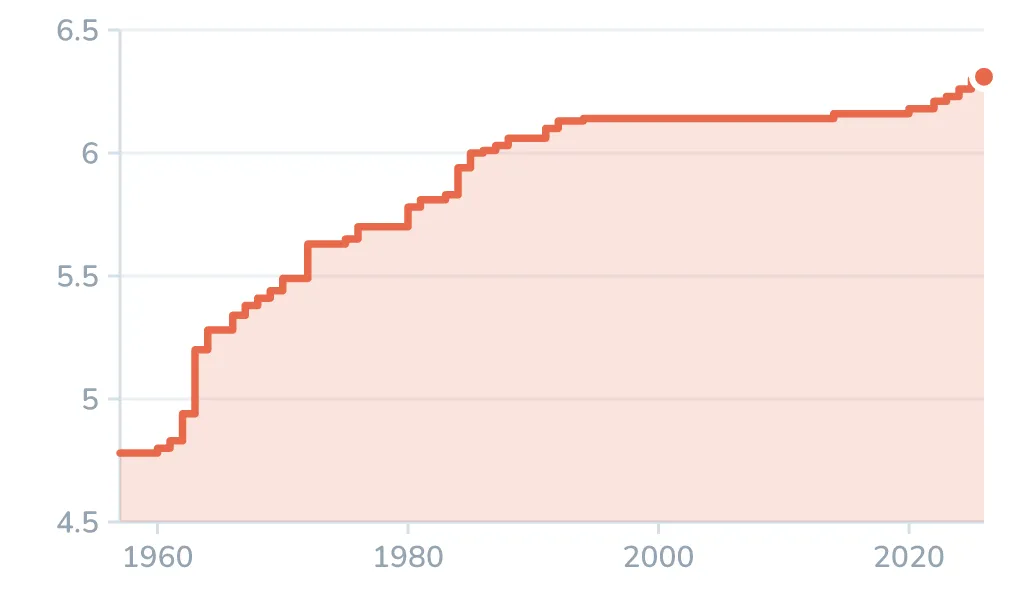
Of course it's not immediately obvious what this chart's title would be, but we do have some clues that help narrow the search space.
The X axis. Observing the X axis range, we can be fairly certain it's showing us how something has changed over the past seven decades.
The Y axis. The Y axis doesn't provide as much information, but we can at least notice that it's a fairly small range. Whatever "it" is goes from ~4.75 to ~6.25 in these seven decades. Though since we do not have units, this could still be a large range. It's very important to know if the chart range is simply 4.5 to 6.5, or if it's in thousands or billions.
The shape. Another important detail is that the value changes in steps, not continuously. Whatever was measured here moves in discrete hops from one value to the next.
Thankfully, an Unlabeled puzzle contains another crucial set of hints: the pool of axis labels to choose from, as well as the other three charts in the puzzle.
This post is about a couple of labels in particular: the actual answer for this chart's Y axis, and the decoy that most players placed there instead.
The other clues: ten labels and three other charts
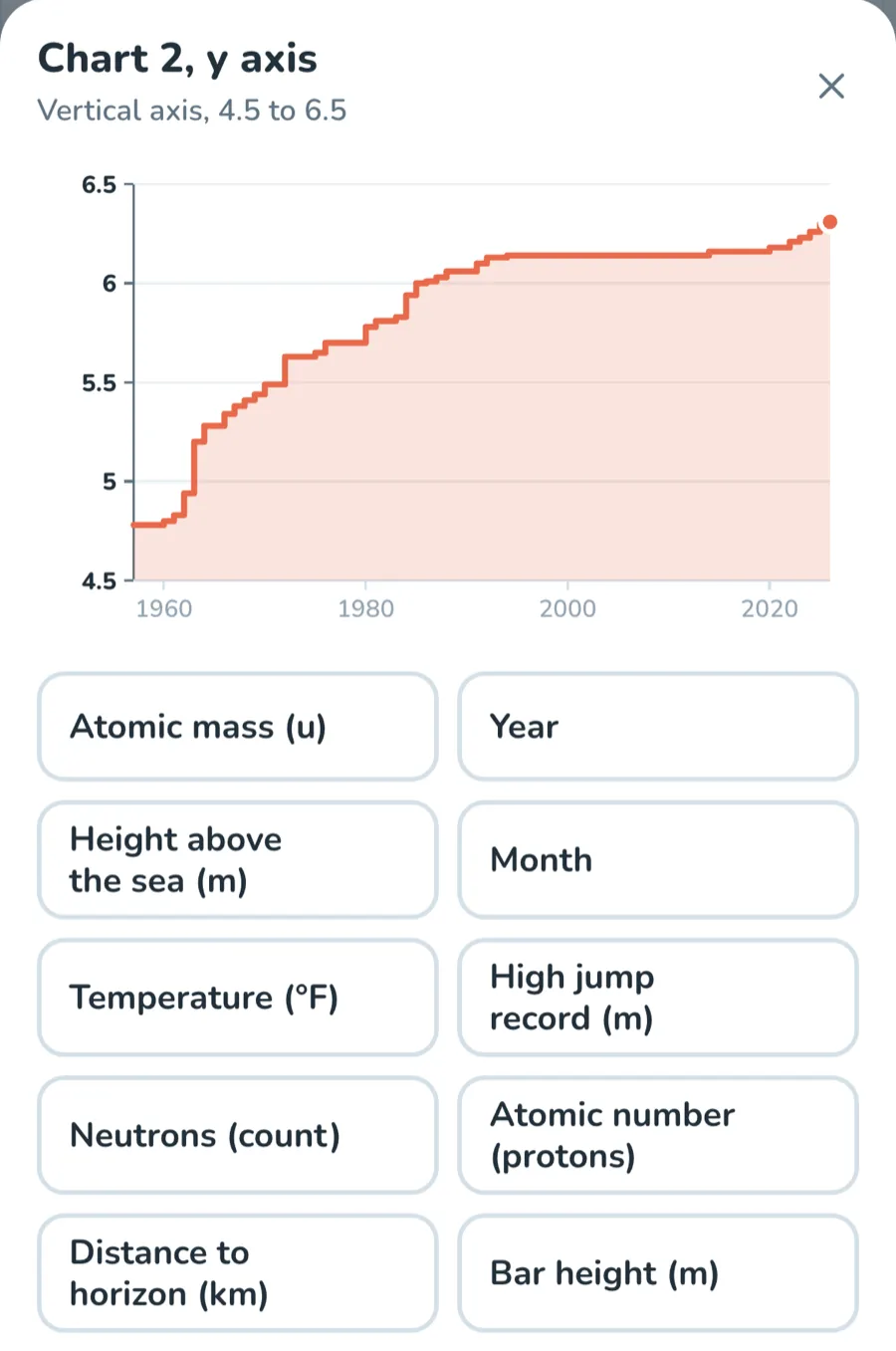
An Unlabeled puzzle presents players with four charts with missing labels, a pool of ten labels to choose from, and up to four attempts to assign them correctly to all four charts.
Here are the ten labels from this puzzle:
| Year | Month | Temperature (°F) |
| Atomic number (protons) | Atomic mass (u) | Neutrons (count) |
| Height above the sea (m) | Distance to horizon (km) | Bar height (m) |
| High jump record (m) |
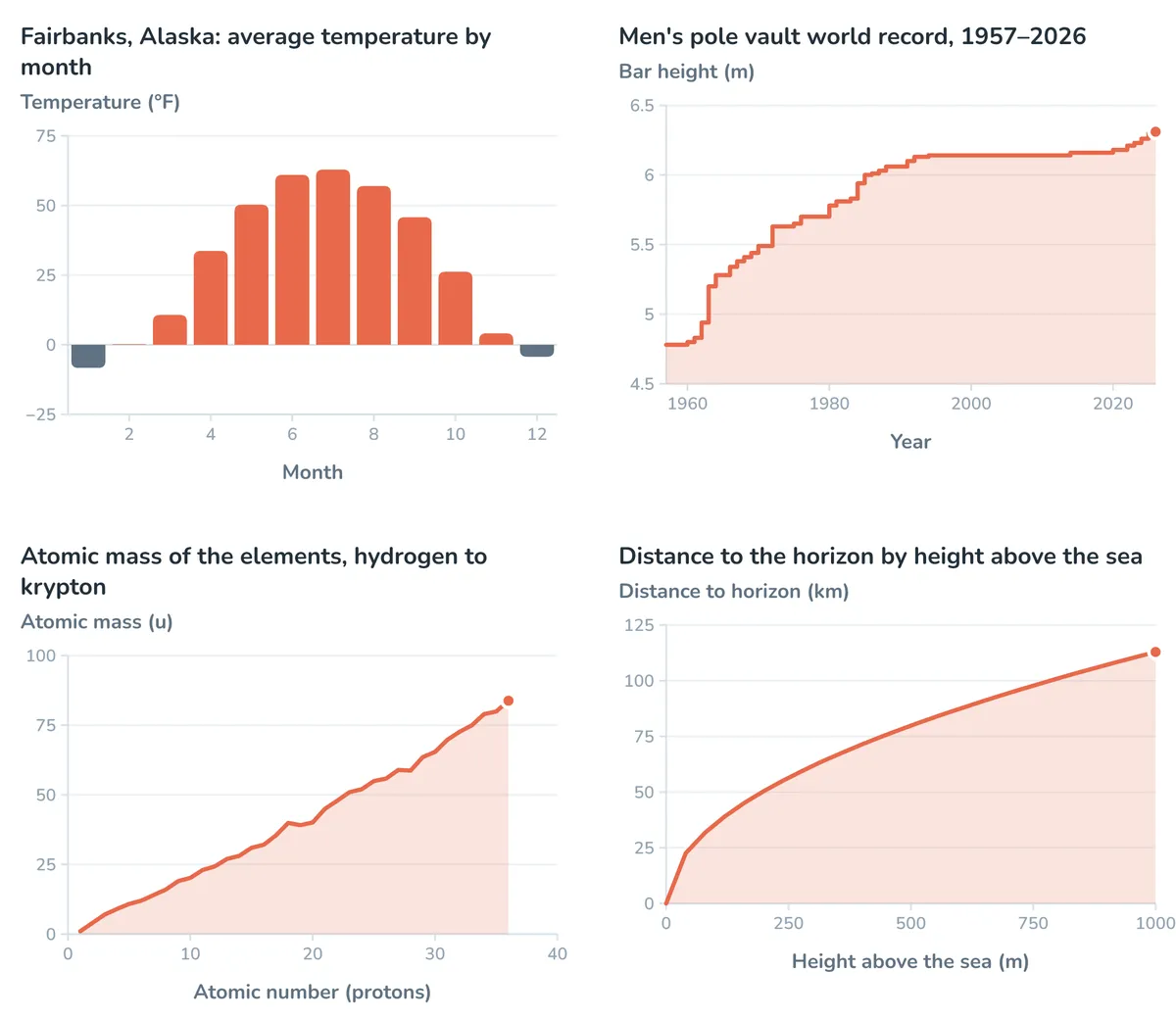
And the puzzle's other three charts:

Now we have a lot more information to work with! I'll walk through one possible thought process:
The X axis:
- Year. The X axis obviously takes Year, unless one of the other charts is showing some very old trend, which is unlikely.
Ruled out for the Y axis:
- Month. We can rule out Month with high confidence.
- Atomic mass. That doesn't seem like something that would change in discrete steps over some number of decades.
- Height above the sea (m). It could be represented here, but it's hard to think of something growing in discrete steps across a couple of meters that was worth measuring. We're probably ruling that one out.
- Temperature. Ruled out, since a trend across decades wouldn't move discretely; it would move continuously.
- Neutrons (count). Definitely not.
- Atomic number. Also definitely not.
- Distance to horizon (km). Again, the shape of the graph probably rules this out.
Still in the running:
- High jump record (m). Definitely a candidate, but needs more thought.
- Bar height (m). This is plausible, but what 'bar height' are we talking about here?
We are left with two plausible candidates: high jump record (m) and bar height (m). We could have done an analysis on the other three charts for a process of elimination, but this is probably enough to think through.
Can you think through what it would be before reading on?
Bar height or high jump record?
- High jump record (m) feels like a good candidate. First of all, it provides more information compared to the vague 'bar height', and the incremental hops over time make sense.
- Bar height (m), on the other hand, could move discretely, but who knows? What if it's a bar floating in water that rises slowly but continuously over time? We have no idea what this bar is.
I believe this is where most players landed on high jump record, in much faster fashion.
But a closer analysis of the Y axis range values is the last important mental step. The crucial insight is that 6.25 meters is ~20.5 feet! I think most people would agree that nobody is jumping to such great heights, unless the jump refers to something else doing the jumping. Here I do depend on most people knowing that jumping high + world records has something to do with a track and field event. And so here we can conclude that it does not represent the high jump world record.
Answer: We're left with bar height, and indeed the chart represents the men's pole vault world record over time.
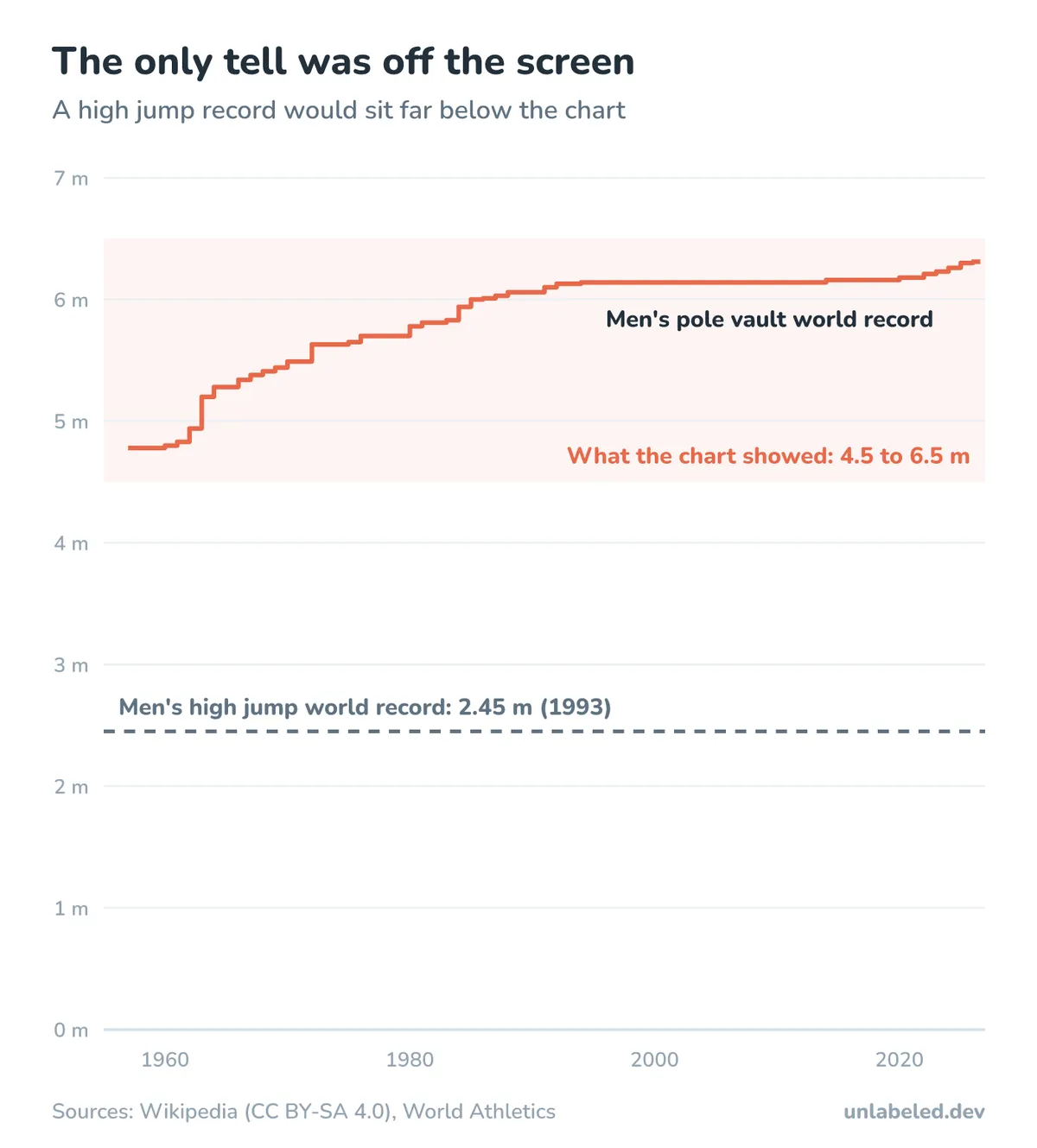
As a bonus, the chart has a nice story of its own. The record was 4.78 m at the end of 1957 and has been broken repeatedly since then, reaching 6.31 m today. The biggest single-year jump was 0.26 m in 1963, when fiberglass poles replaced the older, more rigid ones.
What players chose
| On the Y axis at the first check | Games | Share |
|---|---|---|
| High jump record (m), the decoy | 72 | 75% |
| Bar height (m), the right answer | 10 | 10% |
| Height above the sea (m), another chart's label | 9 | 9% |
| Something else | 5 | 5% |
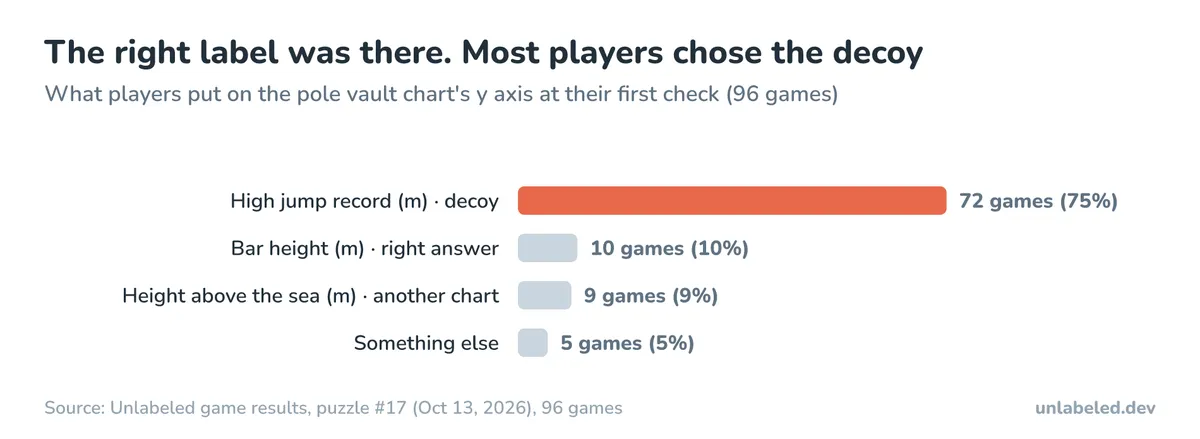
Three of every four players selected High jump record (m) as this chart's Y axis for the first Check. One in ten players placed the correct label (the rest chose one of the other labels).
What I find most interesting is that in 65 of those 72 games, Bar height (m) wasn't used at all. It was sitting in the pool, unused, usually with the decoy in its place. This is an effectively chosen decoy at work. Crucially, the clues exist to avoid the trap, but it's easy to overlook them.
Most players adjusted correctly after the first check
| Check | Games with the decoy on the pole vault chart |
|---|---|
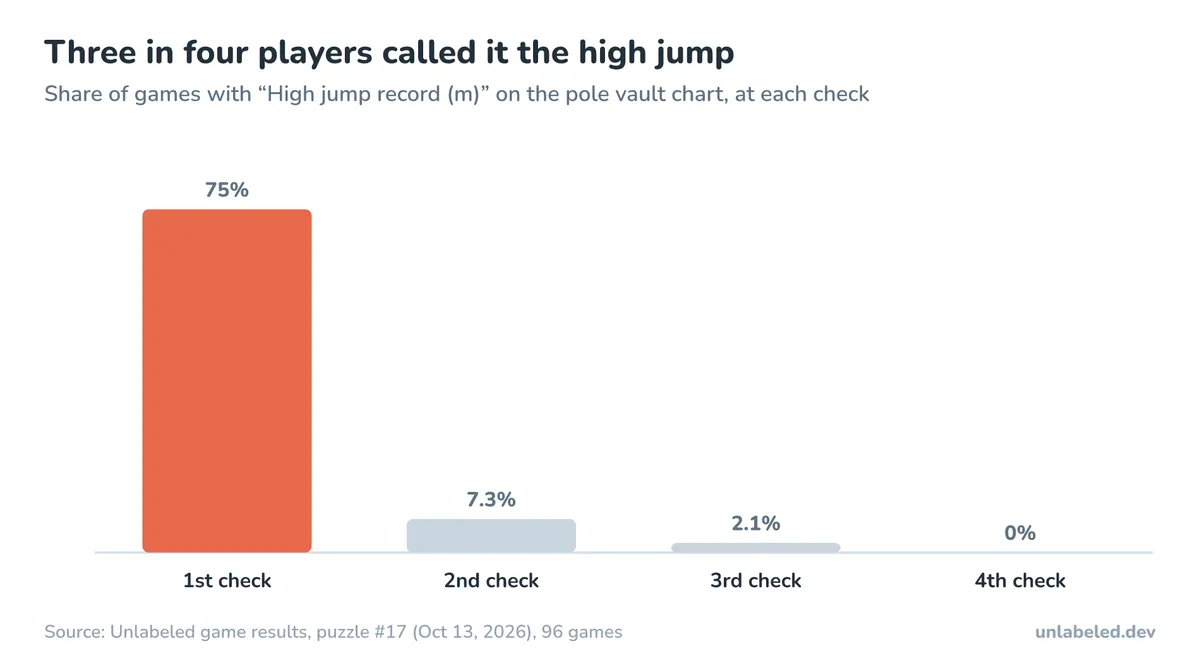
| 1st | 72 (75%) |
| 2nd | 7 (7%) |
| 3rd | 2 (2%) |
| 4th | 0 |
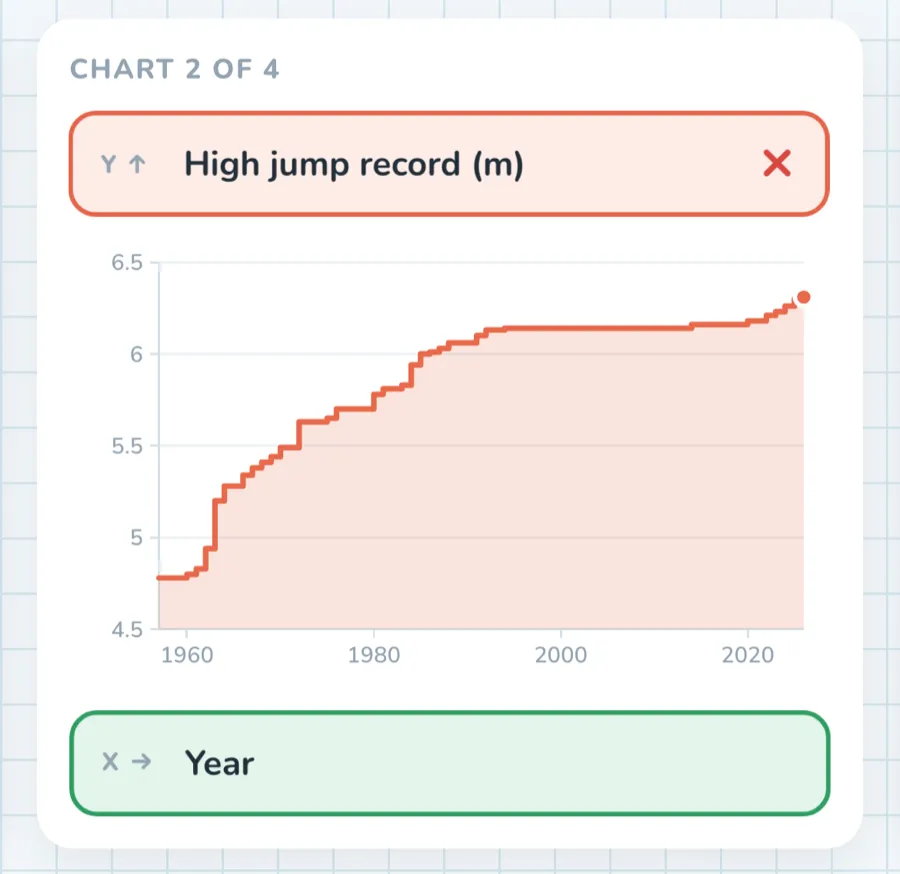
The good news is that once the game marked it wrong, almost everyone accurately fixed the error.
That makes sense. If you've narrowed it down to two labels and one of them is wrong, the other one must be right. I try to design decoys such that they shouldn't usually throw the whole game, and in this case that goal was accomplished.
What one label did to the day
| Puzzle #17 | |
|---|---|
| Games | 96 |
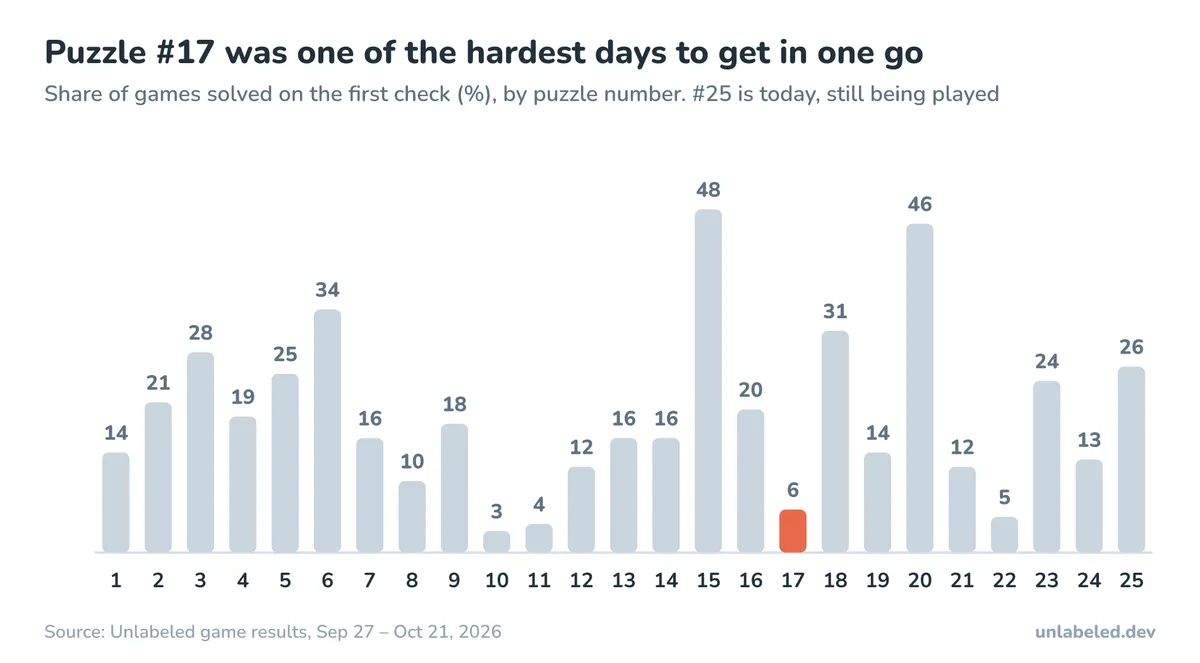
| Solved on the first try | 6.2% (4th lowest of 25; the median puzzle is 16.4%) |
| Solved in the end | 92.7% |
| Labels right on the first check | 4.99 of 8 on average |
| Median time to solve | 3.4 minutes |
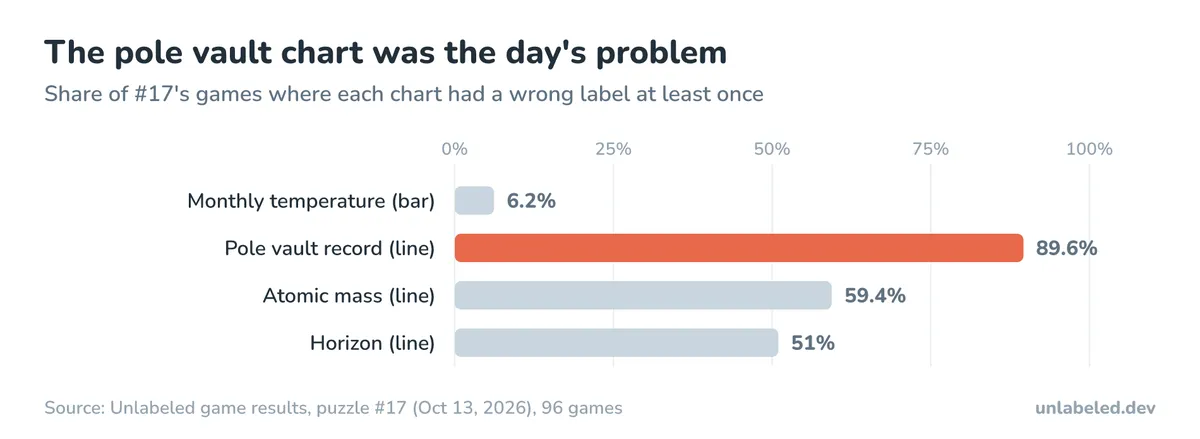
Since most people spent their first check on the high jump decoy, only 6% of games were solved on the first attempt, where a typical day gives about 16% a first-try solution.
So we have enough evidence to say that one decoy drove most of the puzzle's difficulty. And this doesn't only apply to this day's puzzle. In the hardest puzzles since launch, the same pattern emerges where the decoys are the primary parameter to adjust for adding or removing difficulty.
When I first began designing these, I focused on "trap" labels, where two interchangeable labels were valid puzzle answers, but theoretically easy to mix up between two charts. Players didn't fall for these like I thought they would, but analyzing the play data pointed me toward a greater focus on decoy labels.
What makes a good decoy
So was High jump record a good decoy? I think a decoy has to satisfy a couple of important criteria:
- It must be plausible. It has to attract players toward a wrong answer. It can't be too obviously incorrect.
- It must be beatable from the screen. But it also can't be a toss-up. I want players to be able to reason through the puzzles, not simply guess (although I do have feedback that depending on the time of day and other factors, players are more prone to guessing, which if you're willing to sacrifice a try is a pretty good way to get more information).
Depending on your perspective, you could go either way on judging the second. An American solver, for example, might not appreciate having needed to convert meters to feet in order to imagine the jump more effectively. But we can at least conclude that the decoy was plausible, solely on the basis that so many people placed it.
This puzzle and those with similar results have changed how I approach designing the puzzles:
- Decoys are a primary way to tune difficulty.
- Decoys must be designed carefully to be both plausible and detectable without overly specific domain knowledge.
Back to the first chart
Take a look at that first chart again...
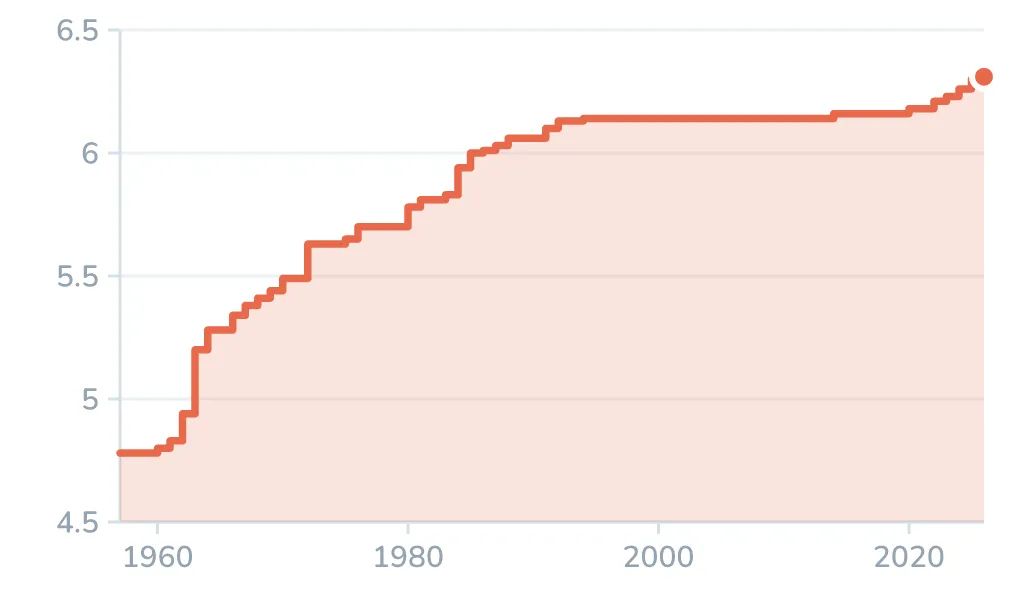
Now that you know it's a pole vault record over time, the discrete changes feel obvious. Records either stay or go up, and sometimes changes to the technology and gear cause larger leaps. That's ultimately what I'm striving for with these puzzles. I want players to walk away with the gratification of having reasoned through the puzzle, perhaps learning something new along the way.
I publish a new puzzle every day. Can you evade the decoys?
Play today's puzzle at unlabeled.dev
Chart data: Wikipedia, "Men's pole vault world record progression" (CC BY-SA 4.0), citing World Athletics. Play data: Unlabeled game results, 96 games of puzzle #17, counted Oct 21, 2026. "First check" means the labels on the board the first time a player pressed Check.